
Climate Change and Global Security: A Defining Challenge for the 21st Century
The planet is at a decisive turning point. Climate change, once seen mainly as an environmental concern, has transformed into one of the greatest threats to international stability, peace, and governance in our time. From intensifying heatwaves and floods to vanishing glaciers and rising seas, the accelerating pace of planetary warming is reshaping economic systems, political priorities, and global security frameworks alike.

Climate Change as a “Threat Multiplier”
Experts often describe climate change as a threat multiplier—a force that worsens pre-existing vulnerabilities in societies and regions. Extended droughts across Africa have increased competition for food, water, and farmland, triggering community conflicts. In South Asia, recurring floods continue to displace millions, stretching humanitarian capacity and deepening cross-border tensions. Meanwhile, low-lying island states in the Pacific face an existential crisis as their territories slowly disappear beneath rising sea levels.
Beyond environmental consequences, climate stress disrupts supply chains, drives migration, and undermines fragile economies. These pressures feed into geopolitical instability, pushing defense and intelligence agencies worldwide to integrate climate-related risk into their strategic assessments and long-term security planning.
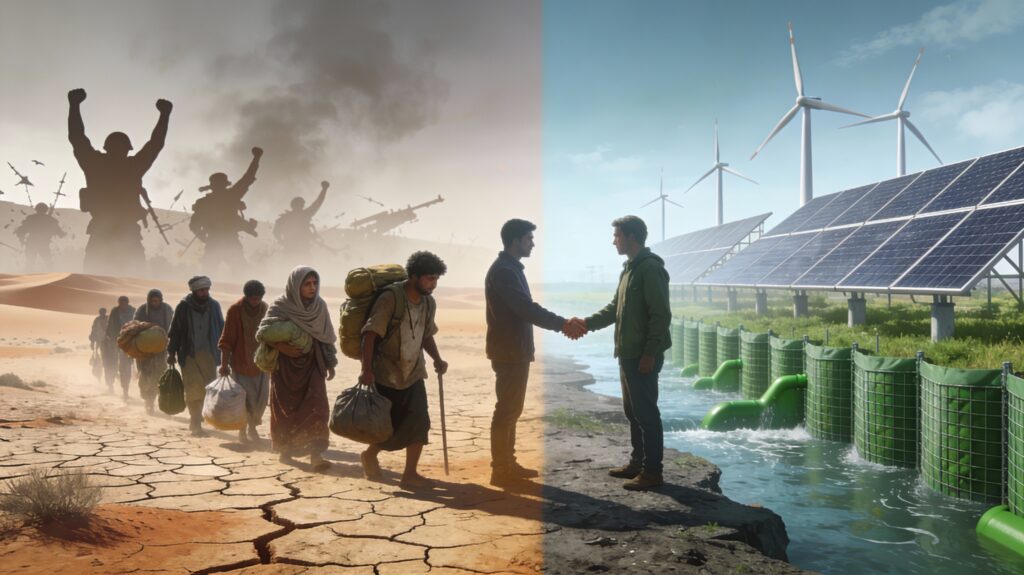
The New Geopolitics of a Warming World
Climate change has now become a driver of global power dynamics. In November 2023, UN Secretary-General António Guterres made global headlines with his address from Antarctica’s melting ice sheets, warning that the world still “isn’t moving fast enough” to confront the crisis. His message underscored a new reality: climate instability is influencing everything from natural resource control to economic competitiveness.
NATO’s 2022 Strategic Concept officially recognizes climate change as “a defining challenge of our time,” linking it directly to alliance security. The UN Security Council frequently discusses climate-linked crises, connecting rising sea levels, drought, and flooding to armed conflict and mass displacement.
Major nations have also woven climate priorities into their geopolitical agendas. The United States now treats clean energy development as a national security and industrial strategy, driving massive investment in renewable infrastructure. China publicly positions itself as a climate leader—even as it continues expanding coal use to support short-term growth. The European Union promotes “green diplomacy,” incorporating carbon policies into trade and foreign relations. These examples show that climate policy is no longer confined to environmental ministries—it has become central to the strategic playbook of global powers.
The Paris Agreement: A Milestone in Global Action
Adopted in 2015, the Paris Agreement remains the most significant framework for international climate cooperation. It unites nearly every nation in the shared commitment to limit global warming to well below 2°C, while striving to cap it at 1.5°C above pre-industrial levels. Its distinctive bottom-up structure allows countries to submit Nationally Determined Contributions (NDCs)—self-defined targets for reducing greenhouse gas emissions.
This flexibility has encouraged broad participation, but effectiveness varies by country. Many nations are still off track to meet their existing goals, and global temperatures have already risen by more than 1.2°C. Without stronger enforcement mechanisms and more ambitious targets, the Agreement risks becoming more aspirational than transformative.
Still, the Paris Agreement represents a remarkable step in uniting the global community under a single vision for collective climate responsibility. It demonstrates that meaningful change depends on mutual trust, transparent action, and shared accountability.

The Critical Role of International Institutions
Institutions such as the United Nations Framework Convention on Climate Change (UNFCCC) play an indispensable role in coordinating worldwide climate efforts. They provide platforms for governments to negotiate, share research, and mobilize funding to support countries most affected by the crisis. The creation of financial mechanisms like the Green Climate Fund and the Loss and Damage Fund further reflects a growing commitment to fairness and global solidarity.
Outside the UN system, organizations such as the World Bank and International Monetary Fund (IMF) are integrating climate resilience into their financial frameworks and debt relief programs. The African Union, G20, and ASEAN have made climate adaptation central to their economic and development agendas. Green investments, carbon credit systems, and renewable energy innovations highlight how climate governance and global economics are becoming increasingly interconnected.
Redefining Global Governance
The accelerating pace of climate change challenges the structures of traditional diplomacy. Old frameworks built around static borders and state-to-state negotiations are no longer sufficient to manage global risks that sweep across continents and decades. Climate change affects energy policy, migration, trade, food systems, and security—demanding cross-sectoral cooperation like never before.
Nations that lead in renewable technology, green innovation, and adaptation infrastructure are likely to shape the future geopolitical landscape. In contrast, those that fail to transition will face widening inequalities, social instability, and loss of influence on the global stage. Effective governance in this century will depend on how well countries adapt to this interconnected and climate-driven world.
From Crisis to Cooperation
The climate emergency is, ultimately, a test of human resilience, governance, and cooperation. It can no longer be treated as a niche environmental issue—it is a fundamental determinant of economic prosperity, global security, and justice. António Guterres’ stark image from Antarctica symbolizes both danger and determination: the melting ice serves as a call to unite rather than divide.
If world leaders, businesses, and communities choose collaboration over confrontation, this defining challenge could become a turning point. A sustainable, secure, and equitable world remains within reach—but only if climate action becomes the central pillar of 21st-century international relations.